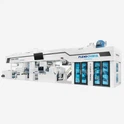
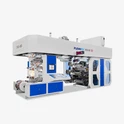
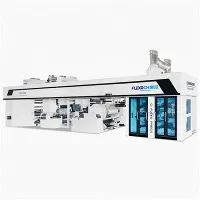
Stack-type flexo printing machine are renowned for their flexibility and rapid job changeover capabilities, making them widely used in printing applications such as food packaging, labels, plastic films, aluminum foil, and more. However,Due to their unique working principles and structural design, stack type flexo presses place specific demands on substrate properties to ensure optimal print quality and operational efficiency.


1. Excellent Surface Flatness and Uniform Thickness
Surface Flatness: If the material surface is uneven, with waves, warping, or bumps, it will cause uneven printing pressure during operation on a stack type Flexo printing machine. Areas with insufficient pressure may result in poor ink transfer, leading to "white spots," while areas with excessive pressure may cause overly thick ink layers, ghosting, or pattern distortion. At high speeds, uneven substrates can also lead to misregistration and even equipment malfunctions.
Thickness Uniformity: The material must have highly consistent thickness. Variations in thickness can cause sudden changes in printing pressure, resulting in uneven color density and registration drift. For web materials such as films and papers, controlling the base material's thickness tolerance is essential for ensuring printing stability.


2. Surface tension: This is usually measured in dyne values. If the surface tension of a material is too low (such as on some plastic films), the ink will have difficulty wetting the surface, causing shrinkage and beading, resulting in unclear printed images and edge defects. Therefore, many non-absorbent materials (such as PE and PP films) often require corona treatment before printing to increase their surface dyne value and enhance ink adhesion.
Adsorption: For absorbent materials (such as paper and cardboard), the surface needs to have a moderate porosity to absorb the binder in the ink and fix the pigment. Excessive adsorption can cause ink dot spread and dull prints; Too little absorbency will result in poor drying and easy smudging when using a stack type Flexo printing machine.


3. Sufficient Mechanical Strength and Stability
Tensile Strength: The material must have sufficient tensile strength to resist stretching or breaking under continuous tension in a stack Flexo printing machine.
Dimensional Stability: During printing, processes such as ink drying and UV curing generate heat, which may cause slight thermal expansion or contraction of the material. If the material lacks dimensional stability, it can subtly affect registration accuracy.


4. Critical Importance of Roll Quality
Winding Uniformity: The roll must be tightly wound with flat edges, avoiding defects such as "telescoping."Irregularly wound rolls make tension control during unwinding and rewinding extremely difficult in a stack flexo press, easily causing wrinkles, tension lines, or even breaks.
Splice Treatment: The web should have as few splices as possible, and any splices must be strong, flat, and without significant thickness increase. A poor splice can cause catastrophic damage to expensive plates and anilox rollers when passing through the impression point at high speed in a stack Flexo printing machine.
Printing Sample