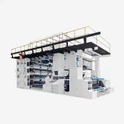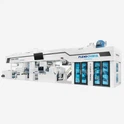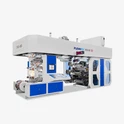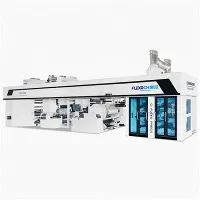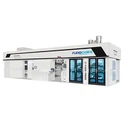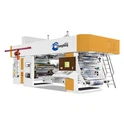
Central Drum CI flexographic printing press are the preferred choice for nonwovens and paper printing due to their high precision, efficiency, and stability. Their unique shared impression cylinder design ensures excellent register accuracy, making them particularly suitable for multi-color, high-volume production. However, achieving optimal printing results on these two substrates with distinct characteristics requires a deep understanding of their properties and precise control of every step of the printing process.


1. Substrate Characteristics: Knowledge is the cornerstone of success.
Nonwovens: They typically have a porous and uneven surface, resulting in strong ink absorption but prone to dot gain. Their elasticity makes them susceptible to stretching under printing tension, affecting registration. Their low surface strength makes them susceptible to linting and pilling.
Paper: Surface smoothness varies greatly (from rough kraft to smooth coated paper), directly affecting dot reproduction. Their ink absorption and surface strength must be matched to the ink to prevent print-through and hair picking.


2.Precision Prepress Matching: Laying the Foundation for Success
- Printing Plate Selection: The hardness of the printing plates used in CI flexographic printing press must be matched to the material. When printing nonwovens, softer plates are generally used to better adapt to their rough surface and ensure adequate ink transfer. When printing smooth paper, slightly harder plates can be used to achieve sharper dots.
- Anilox Roller Pairing: This is crucial for controlling ink volume. Nonwovens, due to their high ink absorption, typically require a higher ink loading capacity, so anilox rollers with lower thread counts and larger ink capacities can be selected. When printing high-quality smooth paper, anilox rollers with higher thread counts and smaller ink capacities are required to reproduce fine dots.3. Precision Process Control: Three Core Elements
Tension Control: The tension control system of a central drum flexo printing machine is the lifeblood of the process. Nonwovens are highly elastic. Excessive tension can cause stretching and deformation, resulting in misregistering; insufficient tension can cause wrinkling. Paper tension must be set according to its weight and strength to avoid breaks or sagging. Maintaining stable and balanced tension across the entire printing line is crucial.


Pressure Adjustment:
- Inking Pressure (Anilox Roller and Plate Roller): Gentle contact is sufficient to ensure even transfer of ink to the printing plate.
- Printing Pressure (Plate Roller and Impression Roller): The essence of flexographic printing machine operation is "minimum pressure for optimal results." Excessive pressure can lead to significant dot enlargement and smearing, especially on nonwovens; insufficient pressure can cause whiteouts and a smudged print.
Video Introduction
Ink and Drying: CI flexographic printing press incorporate efficient drying systems. Due to the rapid penetration drying characteristics of nonwovens, the press's oven must be optimally set to avoid overdrying the surface. For paper, gradient drying is required to ensure thorough curing of the ink layer. The ink system must maintain stable viscosity and pH, which is essential for color consistency.


4.After printing, the anilox roller, plate, and ink tank must be thoroughly cleaned immediately to prevent the water-based ink from drying out and clogging the cells. This is the cornerstone of long-term, stable print quality.
In summary, mastering the art of central drum flexo printing press for nonwovens and paper is a systematic process that begins with understanding the material and continues through prepress matching, process fine-tuning, and post-press care. Only by respecting the nature of the material and guided by data and experience can we consistently produce flawless products with vibrant colors and stable quality in these two broad application areas, thereby gaining core market competitiveness.
Printing Sample