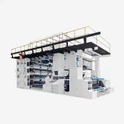
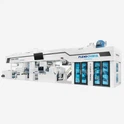
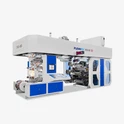
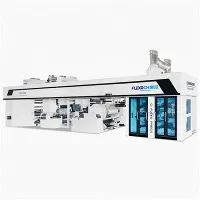
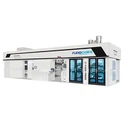
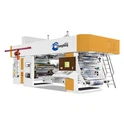
(1) Central impression cylinder and each printing unit
The most fundamental difference between satellite flexographic printing presses and 100-unit flexographic printing presses is that each printing unit shares a central impression cylinder, and each printing unit is distributed around the central impression cylinder. When the printing substrate is close to the impression cylinder for one week, the multi-color printing of each color group is completed.
(2) Non-stop winding and unwinding device
The rewinding and unwinding device of the satellite flexographic printing press generally adopts a DC motor soft connection. Both the unwinding device and the rewinding device form a closed-loop control system. The floating roller tension detection device detects the tension of the unwinding or rewinding, and calculates its value. Feedback to the computer controller, the speed is adjusted by the DC motor, and the tension of each closed-loop system is kept constant at the set value. The unwinding and rewinding parts generally use non-stop rewinding to reduce the loss of raw materials and minimize the drop in production capacity during rewinding.

(3) Drying device
The drying device of the satellite flexographic printing machine is generally divided into two parts, one is the inter-color dryer distributed between the printing units, and the other is the bridge dryer after the printing of each color group is completed. The dryer between each color group is installed between two adjacent color groups. For example, the first color group dryer is installed between the first and second printing units. Its function is to ensure that the wet stack is wet during the printing process of the flexographic printing machine. According to the needs of the process, the printed product after drying by the dryer has formed a film on the surface of the ink, but it is not transparent. Therefore, N-color flexographic printing presses need to be equipped with N-1 inter-color dryers. After the last set of printing units is printed, overprinting is no longer required, so generally no such dryer is added, and the bridge dryer is directly entered. The bridge dryer is actually a drying tunnel designed according to a certain length. Because it is located between the central impression cylinder and the winding device, it is very like a bridge connecting these two components, so it is so called.
(4) Printing substrate cooling device
The printing leads dried by the bridge dryer need to be cooled before winding. Since the general production speed of satellite flexographic printing machines is above 250m/min, air cooling under natural conditions alone cannot meet the requirements of the substrate. Therefore, the cooling is enhanced by the cooling roller with built-in water circulation system, and the surface of the cooling roller is chrome-plated to prevent the condensation of the cooling water from corroding the surface of the roller:
(5) Edge control device for printing substrate
The device is installed in the unwinding and rewinding parts to ensure that the horizontal (end face) of the printing substrate is neat when rewinding and unwinding.
This is a detailed picture of the ci flexo printing machine.