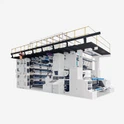
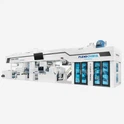
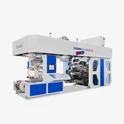
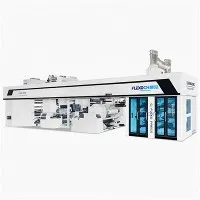
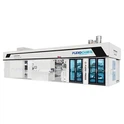
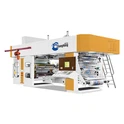
The greatest advantage of the Central impression flexo printing machine lies in: the film is fully adhered to the central impression cylinder, and helping reduce substrate deformation between printing units, which makes it very suitable for PE, BOPP, CPP and other stretchable plastic bag films. The registration is stable, and the speed can be adjusted without registration deviation. The following is divided into eight modules: substrate, ink, screen roller / printing plate, tension and impression, drying, registration, process selection, and quality defect prevention.

1.Substrate and corona treatment
The surface energy of PE/PP virgin film is very low, only 30-34 dynes/cm. The ink cannot be wetted and is easily wiped off.
- Pre-printing corona treatment, the surface energy is increased to 38–44 dynes/cm, detected with a dynometer.
- The corona effect will decay, try to start printing as soon as possible after corona treatment.
- The common thickness of the film is 10–100 μm. Thin PE film (< 20 μm) has extremely strong elasticity and is more sensitive to tension.
- Check the uniformity of film thickness, edge curling, and wavy edges to prevent material deviation and lateral registration drift.


2. Ink selection and viscosity control
For Central impression flexo printing machine printing on plastic films, ink selection and viscosity control are critical because plastic films do not absorb water. Water-based ink and LED UV ink are common choices for plastic bags, while food packaging often requires low-migration ink.
- Water-based ink: special PE/BOPP film-type flexographic ink; the viscosity of Chuanan 3# cup is controlled at 13–22s, monitored in real time to avoid viscosity fluctuations causing color differences and uneven ink layer thickness.
- The surface tension of the ink must be 7-10 dynes lower than the surface energy of the film to ensure wetting and spreading.
- Registration sequence: first print white ink to enhance coverage, then register with colors; The ink viscosity should be properly controlled for each color to maintain consistent ink transfer and print quality.
- LED UV ink: has a fast curing speed, is suitable for high-speed production, has no solvent residue, but requires matching UV lamp power to ensure complete curing.
3. Selection of anilox rollers, printing plates and backing sheets

For a central impression flexo press, plastic bag film is a non-absorbent substrate, so the ink layer should not be too thick. Otherwise, incomplete drying and blocking may occur.
- anilox rollers: Select low-load ceramic anilox rollers to avoid excessive ink volume; for solid areas and large areas of background color, use lower line numbers; for fine text dots, use higher line numbers.
- Printing plates: Select appropriate thickness flexible photosensitive resin plates
- Backing sheets: Control the hardness of the backing sheet; use softer backing sheets for solid color blocks and harder ones for fine text.
- Core principle: Light pressure printing (kiss impression), complete ink transfer justly, do not apply heavy pressure, as heavy pressure will stretch the film, expand the dots and cause misregistration.
4. Segment tension control
Although the center cylinder of the CI flexo printing machine is fixed with the substrate, the unwinding, printing section and winding tension still need to be finely controlled in segments to prevent the film from stretching and deforming, and to avoid misregistration during printing.
- Use low tension to stabilize the material flow, avoiding the film being elongated and causing deformation of the pattern after elongation
- Unwinding uses diameter feedback + floating roller PID closed-loop tension, and the tension in the printing section is kept constant
- Workshop temperature and humidity recommendations: 22–25℃, relative humidity: 50–60%, to reduce static electricity and film deformation
- Install static elimination devices, plastic film production at high speed is prone to generate static electricity, which can cause ink spots, fuzziness, and winding adhesion
5.Registration Control
The Central impression flexo printing machine uses a single central press cylinder for all color groups.
- The central impression flexo press can achieve ±0.1mm stable registration, suitable for multi-color patterns on plastic bags and small text;
- The registration marks are installed in a standardized manner, with real-time closed-loop tracking by photoelectricity;
- The drying temperature should not be too high, as high temperature will cause the plastic film to shrink, resulting in registration deviation of the subsequent color group; a gradient temperature drying method is adopted to avoid one-time high-temperature baking.
 Control Panel
6.Dryer System Settings
Plastic films do not absorb water. Moisture / monomers can only be evaporated from the surface. Insufficient drying will result in sticking, scratching, and color misalignment during winding.
- Water-based ink: combined drying with hot air + infrared, using a gradient temperature rise, from low to high temperature, strictly avoiding sudden heating to prevent film thermal shrinkage.
- LED UV curing: matching lamp power with machine speed to ensure complete ink layer curing.
- The central impression cylinder is equipped with built-in cooling water channels to keep the CI drum at a constant temperature and prevent the film from thermal deformation.
- Each color group is dried fully before moving to the next color group.
7.Plate Control
- The registration precision of the Central impression flexo press scan reach ±0.1mm, suitable for multi-color plastic bags; the fully servo model has better stability in speed change, acceleration, and deceleration registration, and less waste sheets.
- Automatic alignment system + static image monitoring, real-time tracking of registration marks.
- Note: Although there is no stretching between color groups, roll deviation, uneven film thickness, and temperature changes will still cause longitudinal registration deviations.
8.Post-Processing and Bag-Making Compatibility, Quality Control
- Inner printing products: After printing, they are compounded and need to be tested for the peel strength of the compound; the ink must not affect the bonding strength of the compound; for surface-printed products, it is recommended to apply a gloss coating to enhance scratch resistance.
- Inspection items: registration error, color density, adhesion (tape test), abrasion resistance, residual solvent (for food bags), anti-adhesion test.
- Pre-printing files: For flexographic printing, dot compensation should be done; for fine lines and small characters, try to avoid being too small, considering the expansion characteristics of flexographic dots.


9. Common Printing Defects of Plastic Bags and Countermeasures
- Ink smearing and peeling: insufficient dyna value, failure of corona, mismatch of ink, incomplete drying
- registration fluctuation: tension fluctuation, film stretching, excessive drying temperature
- Ink spreading, blurred characters: excessive pressure, excessive load on the mesh roller, improper pad selection
- Adhesion during winding: too thick ink layer, insufficient drying, excessive winding tension
- Static point defects: lack of static elimination device, too low humidity in the workshop


FAQ
Q1:What ink types can be used on a central impression CI flexo printing machine?
A1:The machine supportswater-based inks, solvent-based inks, conventional UV inks, and LED UV inks.
Q2:What is the registration accuracy of a central impression flexo press?
A2:Registration accuracy is typically ±0.1 mm. Certain high-end models deliver even better precision under stable production conditions. Actual registration performance is affected by multiple factors: substrate type, substrate thickness, printing speed, tension control, servo system, plate mounting and operating environment. For film substrates such as PE, BOPP and PET, closed-loop tension control and servo drive systems are critical to maintaining stability.
Q3: How does the machine control substrate tension?
A3: It features segmented tension control with closed-loop feedback adjustment for stable web transport, helping maintain consistent tension and reduce wrinkles, stretching, and registration deviation.
Q4:What are the differences between a flexo press and an intaglio printing press?
A4:A flexo press uses flexible relief plates and anilox rollers to transfer ink, while an intaglio press uses engraved cylinders. Flexo printing is more flexible for different substrates and shorter production runs, while intaglio printing is commonly used for high-volume jobs requiring detailed and consistent printing quality.
Q5:Do you offer installation and commissioning services?
A5:Changhong supplies installation, commissioning and operator training services. Upon machine arrival at the customer's factory, we support on-site guidance, commissioning and trial printing to ensure proficient equipment operation.
Summary
The core logic of Central impression flexo printing machine for printing plastic bags: low tension for stable material feeding, meeting the standard corona dielectric value, film-specific ink, kiss-press gentle contact printing, and gradient constant temperature drying. The central impression cylinder helps minimize cumulative registration errors during multi-color printing., and is suitable for large-scale high-speed printing of PE, BOPP material shopping bags, food packaging bags, and daily-use plastic bags. Changhong Machinery provides high-quality central impression flexo printing machines for flexible packaging. Contact us to discuss your printing requirements.