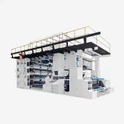
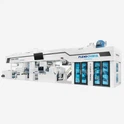
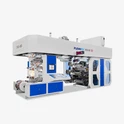
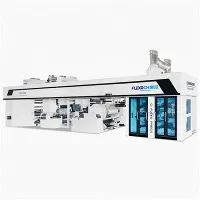
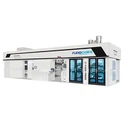
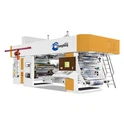
CI flexographic printing presses may have a variety of faults during actual operation. The following are some common faults and their causes:
Registration accuracy problem
Fault manifestation: The printed pattern deviates in the longitudinal or transverse direction and cannot be accurately registered.
Cause analysis: It may be that the plate roller is not installed accurately, and the eccentricity or circular runout of the plate roller exceeds the allowable range; it may also be that the tension of the printing material is unstable during the transmission process, causing the material to deviate; in addition, the registration system of the printing press has a fault, such as sensor failure, improper control system parameter setting, etc., which will also affect the registration accuracy.

Ink transfer problem
Fault manifestation: The ink is transferred unevenly during the printing process, resulting in uneven color depth of the printed pattern, or local ink shortage.
Cause analysis: Improper ink viscosity and drying speed will affect the transfer performance of the ink. If the viscosity is too high, it is difficult for the ink to transfer from the ink roller to the printing plate; if the viscosity is too low, ink splashing and plate sticking are likely to occur. If the drying speed is too fast, the ink will dry prematurely on the ink roller or printing plate, affecting the transfer; if the drying speed is too slow, the printed product will not dry well and will be easily rubbed. In addition, the wear of the ink roller, uneven pressure and quality problems of the printing plate can also lead to poor ink transfer.
Printing pressure problem
Fault manifestation: Uneven printing pressure will make the printed pattern clear in some places and blurred in others, or there will be local ink accumulation.
Cause analysis: The adjustment of printing pressure needs to be reasonably set according to factors such as the thickness and hardness of the printing material and the type of printing plate. If the pressure is too high, the plate will be worn out, and even the plate and the impression roller will be damaged. At the same time, the printed product will be deformed, wrinkled and other problems; if the pressure is too low, the ink transfer is not sufficient and the printed pattern is not clear. In addition, the surface flatness of the impression roller and the wear of the bearings will also affect the uniformity of the printing pressure.


Drying system failure
Fault manifestation: The printed product is not completely dried, the ink surface is sticky and easily contaminated; or excessive drying causes problems such as brittleness and discoloration of the printed product.
Cause analysis: The unreasonable setting of the temperature, wind speed and air volume of the drying system is the main cause of the drying problem. If the temperature is too low, the wind speed is too slow or the wind volume is insufficient, the ink drying time will be prolonged or even unable to dry; if the temperature is too high, the wind speed is too fast or the wind volume is too large, the solvent in the ink may evaporate quickly, resulting in the formation of a hard film on the surface of the printed matter, the internal ink cannot dry, or the printed matter will be deformed, discolored, and other problems. In addition, damage to the heating element of the drying system, fan failure, and blockage of the ventilation duct will also affect the drying effect
Video Introduction
The following is the workflow of an gearless ci flexog printing press.