Hey there! As a supplier of Plastic Bag Flexo Printing Machines, I know how crucial it is to pick the right anilox rollers for your machine. Anilox rollers play a super important role in flexo printing, especially when it comes to plastic bag printing. They're responsible for transferring the right amount of ink onto the printing plate, which directly affects the quality of the print. So, let's dive into how you can choose the perfect anilox rollers for your Plastic Bag Flexo Printing Machine.
Video Introduction
Understanding Anilox Rollers
First things first, what exactly are anilox rollers? Well, they're engraved cylinders that have a pattern of tiny cells on their surface. These cells hold and transfer the ink to the printing plate. The size, shape, and density of these cells determine how much ink is transferred, which impacts the print quality.
There are different types of anilox rollers, and the two main ones are ceramic and laser-engraved anilox rollers. Ceramic anilox rollers are popular because they're durable and can withstand the wear and tear of the printing process. Laser-engraved anilox rollers, on the other hand, offer more precise cell shapes and sizes, which can result in better print quality.
Factors to Consider When Choosing Anilox Rollers

1. Line Screen
The line screen of an anilox roller refers to the number of cells per linear inch. A higher line screen means more cells per inch, which can transfer a thinner layer of ink. This is great for printing fine details and high-resolution images. For plastic bag printing, if you're printing detailed logos or small text, you might want to go for a higher line screen, like 600-1200 lines per inch.
On the flip side, a lower line screen has fewer cells per inch and can transfer a thicker layer of ink. This is better for solid colors and large areas of coverage. If your plastic bags have big blocks of color, a lower line screen, around 200-400 lines per inch, could be a good choice.
2. Cell Volume
Cell volume is another important factor. It's measured in billion cubic microns per square inch (BCM). The cell volume determines how much ink the roller can hold and transfer. A higher cell volume means more ink can be transferred, which is useful for opaque inks or when you need a heavy ink deposit.
For plastic bag printing, the cell volume you choose depends on the type of ink you're using and the effect you want to achieve. If you're using a fast-drying ink, you might need a lower cell volume to prevent over-inking. But if you're going for a rich, vibrant color, a higher cell volume could be the way to go.
3. Ink Type
Different inks have different viscosities and flow properties, so the type of ink you're using matters when choosing anilox rollers. For example, water-based inks are thinner and flow more easily than solvent-based inks. So, you might need a different anilox roller for water-based inks compared to solvent-based inks.
Water-based inks usually require a higher line screen and a lower cell volume to prevent the ink from spreading too much. Solvent-based inks, on the other hand, can work well with a lower line screen and a higher cell volume.
4. Printing Speed
The speed at which your Plastic Bag Flexo Printing Machine operates also affects the choice of anilox rollers. At higher printing speeds, the ink needs to be transferred quickly and evenly. A roller with a higher line screen and a lower cell volume can help with this, as it can transfer the ink more efficiently.
If your machine runs at a slower speed, you have more flexibility in choosing the anilox roller. You can use a roller with a lower line screen and a higher cell volume to achieve a more saturated print.
Detail Image


Our Plastic Bag Flexo Printing Machines and Anilox Rollers
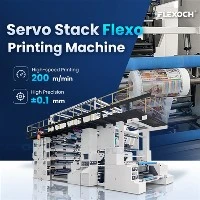
At our company, we offer a range of Film Flexo Printing Machine, 4 Colour Flexo Printing Machine, and Slitter Stack Type Flexo Printing Machine. We understand that choosing the right anilox rollers is essential for getting the best results from these machines.
That's why we work closely with our customers to help them select the most suitable anilox rollers for their specific printing needs. Whether you're printing simple designs or complex, high-resolution graphics on plastic bags, we can recommend the right anilox rollers to ensure a top-quality print.


Testing and Evaluation
Once you've chosen an anilox roller, it's a good idea to do some testing and evaluation. Print a sample batch of plastic bags using the roller and check the print quality. Look for things like ink coverage, color consistency, and sharpness of details.
If you're not happy with the results, don't be afraid to make adjustments. You might need to try a different line screen, cell volume, or type of anilox roller. It might take a bit of trial and error, but finding the perfect anilox roller for your Plastic Bag Flexo Printing Machine is worth it.
Conclusion
Choosing the right anilox rollers for your Plastic Bag Flexo Printing Machine is a crucial step in achieving high-quality prints. By considering factors like line screen, cell volume, ink type, and printing speed, you can make an informed decision.
If you're in the market for a Plastic Bag Flexo Printing Machine or need help choosing the right anilox rollers, don't hesitate to get in touch. We're here to assist you every step of the way and help you get the best results from your printing operations.
References
- "Flexographic Printing: Principles and Practices" by R. A. Black
- "The Anilox Handbook" by Flexographic Technical Association