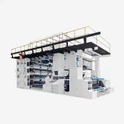
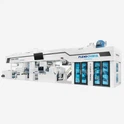
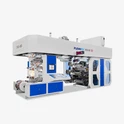
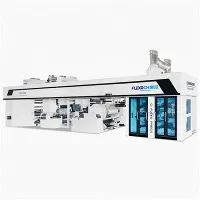
In the flexible packaging industry, high-volume orders place stringent demands on printing speed, register stability, production efficiency and continuous running capacity. For manufacturers producing food packaging, household-care packaging, beverage packaging and industrial packaging, equipment built for long-hour continuous operation effectively boosts output and cuts production-related waste.
So, is a Central Impression Flexo Press suitable for mass-production?
The answer is yes. Featuring a central impression drum structure with multiple printing units arranged around this central drum, the CI flexo press enables PE, PP, BOPP, PET, CPP and other flexible films to undergo multi-colour continuous printing under stable conditions. It is especially well-suited for high-speed, long-run and high-volume flexible-packaging production.

1. What is a Central Impression Flexo Press?
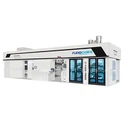
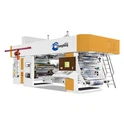
Central Impression (CI) Flexo Press is professional equipment for flexible packaging printing.Its defining feature lies in multiple printing colour stations arranged around one large central impression drum. During production, film substrates run closely against the central impression drum and pass through successive colour stations to complete multi-colour printing.
Compared with conventional configurations, the central impression drum delivers solid support for flexible films. It minimises material fluctuation and register drift at high running speeds, making it ideal for continuous production tasks that require consistent printing performance.
Material Feeding Diagram

2.Why Central Impression Flexo Press Works Well for Mass-Production
High-speed Continuous Printing
Production efficiency is a core requirement for large-batch manufacturing. Central Impression Flexo Printing machine support stable high-speed continuous operation. Multi-colour printing is completed in one single web pass, cutting unnecessary downtime and repeated handling.
For high-volume items such as food pouches, frozen-food packaging, pet-food bags and household-care packaging, reliable high-speed performance lifts output per hour and shortens overall production lead-time.
Note that a machine's maximum mechanical speed does not equal practical running speed. Actual throughput is affected by substrate type, printing width, ink formulation, plate artwork and drying performance. Manufacturers should evaluate equipment against real-world product requirements during selection.
Stable Web Transport
Plastic films including PE and BOPP or PET are thin and pliable. They call for precise tension control and steady web movement under high-speed printing conditions.
Backed by the supporting central impression drum, substrates maintain stable conditions across all printing stations, securing consistent multi-colour register performance.
During extended continuous runs, stable web behaviour reduces reject rates caused by register errors and raises effective production output.


Optimised for Long-run Orders
Central Impression Flexo Press excel at mass-volume, long-run and repeat-order jobs. For instance, when identical food-packaging bags run for tens of thousands or more copies, the machine sustains stable long-hour operation and fully leverages its high-speed advantages.
It delivers a strong production match for converters handling fewer SKUs with large per-order quantities.
Capable of Multi-colour Packaging Printing
Modern packaging commonly features logos, texts, patterns, colour gradients and product information, so multi-colour printing represents a standard requirement within flexible-packaging manufacturing.
CI flexo press can be configured with different numbers of colour stations to finish multi-pattern printing in one web pass. The robust central-impression structure preserves register accuracy across colours and meets printing-quality standards for food, beverage and household-care packaging.
Detail Image


3.Substrates Compatible with Central Impression Flexo Press
Central Impression Flexo Press deliver broad substrate adaptability. Besides plastic films such as PE, PP, BOPP, PET and CPP, properly-configured machines can also process paper, non-woven fabrics and composite flexible materials for diverse packaging and industrial-printing applications.
Plastic films rank among the most common substrates, widely used for food, household-care, beverage and industrial packaging. Operators must fine-tune tension, ink and drying parameters for each film type to sustain stable high-speed printing.
Paper substrates include kraft paper, coated cardboard and food-grade paper grades, used for paper bags, food wrappers and daily-goods packaging.
Non-woven fabrics, valued for softness, breathability and durability, find uses in shopping bags, hygiene articles and medical-grade packaging. CI flexo press adjust printing pressure, tension and ink systems to suit non-woven material characteristics.
Composite and other flexible substrates can also be printed subject to product specifications. Materials with varied thickness, grammage and surface properties require matched unwinding, tension management, drying and printing systems to secure stable continuous production.


4.Typical High-volume Packaging Applications for CI Flexo Press
Food Packaging
Food packaging constitutes a key application field, covering snack pouches, frozen-food packs, pet-food bags, vacuum-sealed packs and assorted composite flexible packages. These items usually come in large order volumes and demand fast printing alongside consistent colour reproduction.
Beverage Packaging
Beverage packaging imposes strict standards for brand graphics, texts and colour rendering. Central Impression Flexo Printing machine raise production efficiency through continuous multi-colour printing for high-volume film-packaging assignments.
Household Care Packaging
Laundry detergent sachets, cleaning product packs and personal care wrappers are widely used in everyday consumer products. The equipment supports stable, continuous printing for these packaging applications.
Industrial and Agricultural Packaging
Fertiliser sacks, chemical product wrappers and agricultural packaging often involve large production volumes and extended runs. The equipment can be configured according to different substrates and product requirements for reliable manufacturing.
Printing Sample


5.Beyond Printing Speed: Key Factors for Mass-production
When investing in Central Impression Flexo Press, manufacturers should not focus solely on top mechanical speed. Real-world mass-production efficiency is jointly determined by register stability, tension control, drying performance, job-change efficiency and automation level.
For example, unstable film tension triggers register deviation and higher reject rates even at high running speeds. Reliable unwinding, web-driving and rewinding systems are equally critical.
Moreover, automatic register control, tension management, ink delivery and drying modules must work in synergy to sustain consistent machine performance throughout long production runs.
6.How to Select a Suitable CI Flexo Press for Mass-production
Factories can assess options based on their practical production requirements:
Order profile: Clarify monthly and annual output plus typical per-order batch sizes.
Substrate portfolio: Confirm primary printing materials such as PE, PP, BOPP, PET, CPP or composite films.
Printing width: Determine machine width according to packaging dimensions and product specifications.
Colour count: Decide the number of colour stations based on packaging artwork and expected printing effects.
Practical production speed: Prioritise real-world running speed under actual products and substrates instead of only referencing maximum mechanical speed.
Automation configuration: Select matching features for register adjustment, tension management and quality control in line with efficiency targets.
CI flexo press deserve serious consideration for facilities mainly undertaking large-volume, long-run flexible-packaging assignments.
Video Introduction

7. FAQ
Q1. Is CI Central Impression Flexo Printing machine suitable for mass production?
A1. Yes. The central impression structure supports high-speed, multi-colour and continuous printing, making it suitable for large-volume food, household-care and flexible packaging production.
Q2. What materials can be printed?
A2. Common options include PE, PP, BOPP, PET, CPP, paper, nonwoven and selected composite materials. Compatibility depends on substrate properties, ink system and machine configuration.
Q3. What should be considered for large-volume production?
A3. Key factors include practical production speed, register stability, tension control, drying capacity, colour-station quantity and automation level. Together, these affect output and long-term production stability.
Q4. Can it handle short-run jobs?
A4. Yes. However, businesses with many SKUs, small batches and frequent job changes should also consider changeover efficiency and operational flexibility when selecting equipment.
Q5. How can I determine if it suits my plant?
A5. Consider your typical order volume, substrates, printing width, colour requirements, target output and production cycle. For manufacturers handling large continuous orders, it can provide an efficient and stable production solution.
8.Conclusion
Central Impression Flexo Press are well-suited for mass-production, especially for high-speed, long-run continuous flexible-packaging printing jobs.
The central impression drum delivers firm substrate support and facilitates register control during high-speed multi-colour printing. Adaptable to various flexible substrates including PE, PP, BOPP, PET and CPP, these presses see wide-ranging deployment across food, beverage, household-care, industrial and agricultural packaging sectors.
For converters pursuing stable high-volume output, equipment selection should not be limited to printing speed alone. Substrate compatibility, register accuracy, tension management, drying capability and automation grade should all be weighed to achieve stable and efficient manufacturing performance.