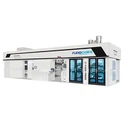
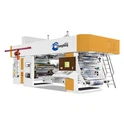
I.What is a CI Flexographic Printing Machine?
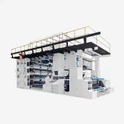
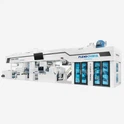
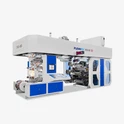
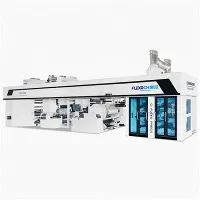
The CI Flexographic Printing Machine (Central Impression Flexographic Printing Machine), also known as the central impression drum-type flexographic printing machine, is a flexible printing equipment specially designed for high-speed and high-precision continuous printing. The equipment uses a large-diameter central impression drum as the unified printing base, and each printing color group is arranged in a circular pattern around the central drum. Each color group consists of a plate roller, a mesh roller, and related ink supply systems.
During the printing process, flexible substrates such as films and papers run closely against the surface of the CI drum and pass through multiple printing units one after another to achieve multi-color registration. Since all color groups share the same central impression cylinder, it effectively improves the stability of material operation and the accuracy of registration, and is particularly suitable for large-scale, high-speed and high-quality printing production of flexible packaging materials such as BOPP, PE and PET.

II. What Are the Advantages of CI Flexographic Printing Machines?
1. Greener and Low-Carbon Performance
- Ink System: Substantial VOC reduction at source
- CI Flexographic printing is the only mainstream printing process that can be used on a large scale and stably with water-based ink.
- Water-based ink uses water as the main dispersing medium and only a small amount of solvents. The VOC emissions are reduced by 70% to 90% compared to solvent intaglio ink, without benzene, ketone, and other strong volatile toxic solvents. The residual solvents in the finished product are extremely low, suitable for food and baby product packaging.

2.Energy consumption of drying and curing systems is lower
CI Flexographic Printing Machines are divided into two major categories: hot air drying system and UV light curing system, which are the most commonly used configurations in the industry.
The drying temperature of the hot air drying system is generally 40% to 60%, much lower than the high-temperature hot air required for solvent intaglio printing, and does not require large air volume for continuous solvent extraction, which is more economical.
LED UV curing is the mainstream configuration for CI Flexographic Printing Machines, with the advantages of immediate on and off without preheating, and compared to traditional mercury lamps, UV reduces 70% to 85% of energy consumption.
3.Lower Production Waste Rate and Reduced Substrate Waste (Hidden Carbon Reduction)
The CI Flexographic Printing Machine features low printing pressure and gentle application of flexible printing plates, making it less likely for films and thin papers to stretch or be damaged. At the same time, the CI Flexographic Printing Machine has stable overprinting and fewer rejects upon startup. Industry data shows that the waste rate of flexographic printing is generally 1% to 2%, which is lower than that of traditional intaglio printing. The production of substrates (plastic films, paper) itself has a high carbon emission, and reducing waste is a significant way to reduce carbon.


III. The Printing Stability Is Stronger And The Process Is More Efficient
All color groups share the same central embossing cylinder. The substrate is continuously fed along the cylinder, significantly reducing the deformation of stretchable materials such as films and non-woven fabrics. The high-speed registration performance is excellent.
The embossing conditions are uniform, and the restoration effect of fine grids, gradients, and small text is good. The color consistency of each batch is high. All color printing is completed in one feeding process, making it suitable for large-scale continuous production; by connecting the matching cylinder and plate roller, the changeover speed is fast.


IV. Compact Machine Layout with Smaller Footprint
In the central impression flexo printing machine all the printing color groups are arranged around the same central impression cylinder in a circular pattern. The color groups are arranged radially along the circumference. Unlike traditional intaglio printing where each color group is arranged longitudinally in series along the material feeding direction, the substrate in the units is suspended and the material path is controlled by tension. Under the same number of color groups, the CI Flexographic Printing Machine significantly shortens the overall machine length, and the occupied area of the factory is much smaller than that of the intaglio printing machine.
This effectively saves the space of the workshop and reduces the cost of factory infrastructure and site investment for customers. At the same time, the compact circular layout shortens the material feeding path of the roll and reduces the suspended section of the roll, further reducing the risk of roll vibration and stretching deformation. While saving the site, it also assists in improving the registration accuracy. For soft packaging factories with limited factory space, this is a very prominent selection advantage.
Video Introduction
V. What Are The Core Driving Forces Behind The Mainstreaming Of CI Flexo Printing Machines?
1.CI Flexographic Printing machines have become the mainstream machines for medium and high-end flexible packaging
The market is clearly segmented, and CI Flexographic Printing Machine dominate the production of medium-speed and high-speed flexible packaging for films, such as food bags, cosmetic films, and logistics packaging products. The center drum structure has stable tension and can achieve a printing accuracy of ±0.1mm, which can solve the problem of printing on ultra-thin stretched single-recycled films.
Continuous automation upgrades: The dual-station non-stop configuration has been widely adopted, reducing downtime and reducing raw material losses is the core demand of printing factories. More and more buyers are choosing dual-station roll-fed flexographic printing machines to achieve non-stop rewinding and continuous production. At the same time, automatic registration, closed-loop color control, online inspection, remote monitoring, and predictive maintenance have gradually moved from value-added options to standardized configurations. Automation reduces the reliance on skilled operators and effectively reduces the loss during machine switching and testing.
The substrate adaptation range is wide, with the demand for single-material recycled films, kraft paper, PLA biodegradable films, and non-woven fabrics continuously rising. These new materials have poor heat resistance, are easily stretchable, and have strong ink absorption, which pose new requirements for the tension system, ink transfer, and drying of the equipment. Flexographic printing machine manufacturers continuously optimize servo tension modules to achieve stable printing on LDPE, LLDPE, BOPP, PET, nylon, kraft paper, and biodegradable films. Machines that can only print on a single substrate will continue to lose competitiveness.


2. The global market landscape is undergoing differentiation, with emerging markets releasing significant growth potential
The mature markets in Europe and the United States are mainly driven by the need for upgrading old equipment, energy conservation, and the demand for high-end automated machines; while in Southeast Asia, Latin America, the Middle East, and Africa, the growth momentum is strong, with local consumer goods and food packaging production expanding, leading to an increase in the purchase of flexographic equipment. CI Flexographic Printing Machines, with their high cost-effectiveness and stable performance, have been widely recognized by global processing plants. Additionally, the flexographic + digital hybrid printing solution is gradually seizing the niche market of small-batch and multi-SKU customized packaging, forming differentiated competition.
In addition to the CI Flexo Printing Machine, we also offer a stack-type flexographic printing machine, which is suitable for enterprises with lower production volumes and represents a cost-effective solution. Our two-station continuous central impression flexo printing machine is another ideal choice for large-scale printing. Its two-station design enables continuous printing, reduces downtime, and enhances production efficiency. This printing machine has been specially designed to ensure efficient ink transfer, thereby achieving high-quality printing results.
Ⅵ.Summary
The main development direction of the flexographic printing machine industry in 2026 revolves around four aspects: environmental compliance, high automation, wide-range substrate compatibility, and stable printing accuracy. CI Flexo Printing Machines equipped with dual-station non-stop system, LED UV curing, and intelligent tension control will enjoy the largest market growth. For packaging plants, new equipment investment should be combined with the long-term trend of green packaging, and choose expandable and upgradable flexographic printing equipment to seize orders in the sustainable packaging sector.
If you are interested in our CI Flexo Printing Machine or wish to learn more about the prospects of flexographic printing machines, Please do not hesitate to reach out to us for procurement-related negotiations. We are committed to helping you fully utilize the performance advantages of printing equipment.