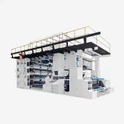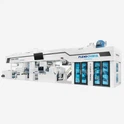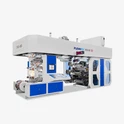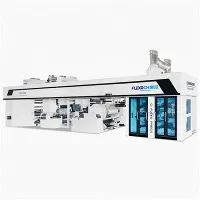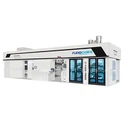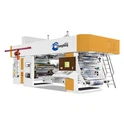
In today's packaging and printing industry, flexographic printing is now a mainstream process – it's eco-friendly, works with many different substrates, and is ideal for high-volume continuous production. The CI (Central Impression) flexo printing machines is a leading model of high-end flexo equipment. It has a unique structural design, runs stably, and delivers precise printing results, so it's widely used in flexible packaging, paper packaging, label making and other fields. For manufacturers, it's core equipment to lift productivity and improve print quality. This article looks at the flexo press's core technologies, key advantages, practical efficiency solutions and important supplementary details, giving a concise, professional technical introduction to help users really understand the equipment and make the most of its performance.

CHCI-E-S 8 Color Central Drum Flexo Printing Machine With Servo Winder
I. Definition, Structural Principle of CI Flexographic Printing Press
1. Core Definition
A CI flexographic printing press, also known as a central impression flexo press, is a type of flexible letterpress equipment and one of the most structurally stable and high-precision register models in the flexographic machine category. Its key feature is a single large-diameter central impression drum with multiple printing decks arranged circumferentially. Each independent printing unit is evenly distributed around the central drum, and the substrate runs tightly against the drum surface throughout the process to complete multi-color register printing in sequence.Compared with stack-type and unit-type flexo printing machines, it features a shorter substrate path, less tension fluctuation, and significantly improved printing stability.
Parameters
|
Model |
CHCI8-600E-S |
CHCI8-800E-S |
CHCI8-1000E-S |
CHCI8-1200E-S |
|
Max. Web Width |
700mm |
900mm |
1100mm |
1300mm |
|
Max. Printing Width |
600mm |
800mm |
1000mm |
1200mm |
|
Max. Machine Speed |
350m/min |
|||
|
Max. Printing Speed |
300m/min |
|||
|
Max. Unwind/Rewind Dia. |
Φ800mm/Φ1000mm/Φ1200mm |
|||
|
Drive Type |
Central drum with Gear drive |
|||
|
Photopolymer Plate |
To be specified |
|||
|
Ink |
Water base ink or solvent ink |
|||
|
Printing Length (repeat) |
350mm-900mm |
|||
|
Range Of Substrates |
LDPE, LLDPE, HDPE, BOPP, CPP, OPP,PET, Nylon, |
|||
|
Electrical Supply |
Voltage 380V. 50 HZ.3PH or to be specified |
|||
2. Core Structure and Working Flow
- This drum flexo printing machine features a modular integrated design with six core components:
- Unwinding and web guiding unit
- Central impression drum
- Circumferential printing units
- Inter-color and final drying units
- Closed-loop tension control system
- Rewinding unit
Its workflow is smooth and fully continuous:
- The unwinding unit feeds the substrate, which is precisely aligned by automatic web guiding and then closely attached to the central impression drum.
- The substrate goes through each printing unit one by one for single-color transfer; right after each color is printed, the drying system cures the ink at once to avoid color mixing and adhesion.
3.Once full-color printing is done, the substrate is cooled and set, then neatly rewound for subsequent processing-achieving fully continuous and automated production throughout.
Detail Image


II. Core Technical Characteristics of CI Flexo Printing Machine
The high production potential of the press comes from its advanced technical foundation. Four core characteristics form the basis of high productivity and quality:
1. Rigid Structural Stability Technology
The press uses thickened integrated side frames and a large-diameter precision central impression drum, delivering solid rigidity with minimal vibration and no displacement during operation. The central drum undergoes high-precision dynamic balancing and fine surface grinding for full substrate contact. It enables long-term high-speed continuous production, cutting adjustment downtime and keeping production running smoothly.
2. Closed-Loop Precision Tension Control
Equipped with a fully automatic closed-loop tension system, it monitors and automatically adjusts substrate tension in real time across unwinding, printing, and rewinding. This completely eliminates problems such as substrate stretching, wrinkling, and deviation.Especially for deformable substrates like plastic films and thin paper, stable tension control fundamentally ensures register accuracy while reducing material waste, adapting to various flexible substrates.
3. High-Precision Register Technology
Benefiting from the compact CI layout, the printing path is extremely short with small distances between printing decks, free from sudden tension changes and lateral displacement. Register accuracy is superior to conventional CI flexo Printing machines.Even at high operating speeds, it maintains perfect pattern register without frequent downtime for calibration, effectively extending effective production time.
4. Multi-Substrate Universal Compatibility
The press offers strong compatibility, suitable for paper, plastic film, aluminum foil, non-woven fabric, and many other common printing substrates.By slightly adjusting printing pressure, drying temperature, and tension parameters, it can quickly switch between substrates and order types without replacing core components, greatly improving overall equipment utilization and meeting manufacturers' diversified order demands.


III. Production Efficiency Improvement Solutions Based on Technical Characteristics
Improving equipment efficiency is not about blindly increasing speed, but a systematic optimization based on core technologies across six dimensions:preparation, production control, daily maintenance, technical upgrading, personnel operation, and waste control.All solutions are tailored to the structure and features of CI flexo printing machines, with strong practicability for daily production:
1. Simplify Pre-Press Preparation to Reduce Standby Time
- Preparation is critical to efficiency. Using the press's modular and parameter storage functions:
- Standardize material and plate preparation in advance; adopt sleeve-type plate cylinders to shorten plate changing time.
- Preset and store tension, pressure, drying, and other parameters for frequent orders, enabling one-click recall during job changes to eliminate repeated adjustments.
- Verify substrate and ink specifications in advance to avoid unexpected downtime from material mismatches and further reduce changeover gaps.
2. Standardize Production Parameter Control for Continuous Production
Set stable, matched running speeds and drying parameters based on substrate and ink properties, and avoid frequent starts, stops and abrupt speed changes. Make the most of the press's structural stability to sustain high-speed continuous production. Control ink supply for consistent ink output, and work with basic online quality monitoring to prevent defects, cut down on rework and reduce downtime. Prioritize three core parameters in operation: tension, register and drying. Timely fine-tune minor deviations and predict major problems in advance to avoid large batches of defective products.
Video introduction
3. Standardized Operation and Maintenance to Lower Failure Downtime
Equipment stability is the premise of efficient production.
- Establish a regular maintenance plan: clean the central drum, anilox rolls, and plate cylinders regularly to remove ink residue and impurities.
- Inspect servo systems, tension sensors, drying units, and other core components periodically; replace blades, seals, and other wearing parts in a timely manner.
- Perform complete lubrication and electrical maintenance to prevent sudden failures, extend service life, and ensure long-term stable operation.
4. Appropriate Technical Upgrades for Higher Productivity
For older press models, targeted upgrades boost productivity without full replacement:
- Upgrade to servo systems, replacing traditional transmission structures to cut running clearance and boost register accuracy and speed.
- Fit automatic splicing devices for non-stop roll changing, removing reel replacement downtime entirely.
- Add an automatic ink circulation system to stabilize supply pressure and volume, cutting manual work and ink color fluctuation.
- Adopt a digital intelligent control system for real-time production monitoring, remote parameter adjustment and auto report generation, optimizing full-process management and modernizing existing equipment.
Detail Image


5.Standardize Personnel Operation and Improve Proficiency
An operator's skill level directly affects how well the equipment runs. Train staff specifically on CI flexo printing machines, focusing on tension adjustment, register calibration, parameter recall and troubleshooting to stop downtime and defects from wrong operations. Lay down fixed operating steps, define each person's job duties and stop parameter mix-ups when operators switch shifts. Help operators build awareness of equipment care, so they can operate, maintain and deal with emergencies properly, and make human-machine coordination more efficient.
6. Refined Waste Control to Reduce Indirect Cost Loss
Production waste indirectly lowers effective output. Implement refined control based on equipment characteristics:
Control start-up and adjustment time to reduce substrate and ink waste.
Use matched anilox rolls, plates, and blades to avoid uneven ink color and register deviation.
Optimize unwinding and rewinding tension to reduce substrate stretching, wrinkling, and breakage.Reduce material loss while ensuring quality to effectively increase finished product output, achieving simultaneous quality improvement and efficiency enhancement.

Anilox Rolls

Chamber Doctor Blade
IV. Conclusion
With its unique central drum circumferential structure, precise tension, and register control technology, the CI flexographic printing press inherently possesses advantages for high-efficiency production.The key to improving its efficiency lies in process optimization, standardized control, and regular maintenance based on the equipment's technical characteristics, while avoiding operational errors and matching production scenarios accurately.
From equipment principles to practical control, focusing on core technologies-neither blindly speeding up nor neglecting details-can truly achieve triple optimization of productivity, quality, and material loss. This helps manufacturers reduce production costs, enhance market competitiveness, and realize long-term stable and efficient production.