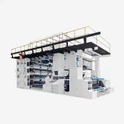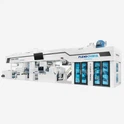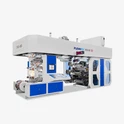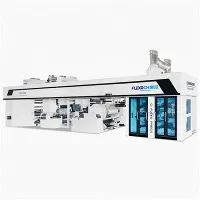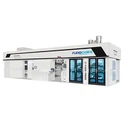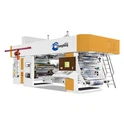
Stack flexo printing machine has become one of the mainstream choices for printing on paper, plastic, and non-woven fabrics due to its efficiency, environmental friendliness, and strong adaptability. However, different substrates impose vastly different requirements on ink adhesion, and effectively addressing this challenge is key to fully leveraging the advantages of flexographic printing.


1. Customized Ink Systems
Paper:The porous structure facilitates ink penetration and anchoring, but precise control of penetration depth and drying speed is necessary to prevent bleeding or poor drying.Water-based inks adjust viscosity and permeability through formulation optimization to ensure eco-friendly, high-efficiency printing on stack flexo printing machine.
Solvent-based inks enable faster drying and special effects but require fine-tuning of solvent-resin balance to manage penetration and film formation.
Plastics (PE, PP, PET, etc.):Smooth, inert, and low-energy surfaces make ink adhesion difficult, while additive migration further complicates the challenge.Solvent-based inks rely on high-adhesion resins, promoters, and precise solvent formulations to achieve good leveling and bonding.
Certain water-based inks are gaining traction in eco-sensitive applications but require strong pre-treatment and high-performance resins for reliable adhesion.

2. Critical Pre-Printing Treatments
Paper Treatment:Coating processes can be applied to optimize surface smoothness and ink absorption as needed.Mild corona treatment may be used to fine-tune surface energy, ensuring uniform ink transfer.
Plastic Treatment:Enhancing surface energy and introducing reactive groups are essential for adhesion.Corona treatment is the most common method for stack flexo printing machine, using high-voltage discharge to oxidize the plastic surface, significantly improving wettability while ensuring immediate and consistent results.
Video Introduction
3. Precise Printing Process Control
The stacked structure of flexographic printing machinery inherently enables fine-tuned adjustments:
Anilox Roller Selection:For paper, lower line count rollers are typically used to carry a thicker ink layer.For plastics, higher line count rollers deliver thinner, more uniform ink films, improving adhesion and drying.
Drying System Management:Independent, adjustable drying units between printing stations allow tailored drying conditions on stack flexo presses.Paper tolerates higher drying temperatures, while plastic films require strict temperature control and stepwise heating to prevent deformation or interlayer adhesion issues.
Pressure Optimization:Pneumatic or servo-controlled impression systems automatically adjust pressure based on paper weight or film thickness, ensuring effective ink transfer without substrate damage.


Conclusion
stack type flexo presses successfully addresses diverse adhesion challenges by deeply understanding the material properties of paper and plastics and implementing targeted strategies in ink formulation, pre-treatment, and printing processes. Its modular design and precision control make it a reliable solution for complex packaging demands.
With the integration of smart and green technologies, stack flexo printing equipment will continue to enhance its adhesion performance and production efficiency, solidifying its core position in modern packaging printing.
Sample